


Betty Palaso Papua New Guinea's Ambassador to the Philippines
Betty Palaso, Papua New Guinea's ambassador to the Philippines, is a remarkable Adventist professional. Noted for her humanitarian services, she is the recipient of distinguished British honors: Officer of the Order of the British Empire (2003) and the Queen Elizabeth Birthday Honour, Companion of the Order of Saint Michael and Saint George (2017).
Palaso was born in the Manus province of Papua New Guinea in the South Pacific. During her early life, she accompanied her missionary family, who served in remote areas in several provinces.
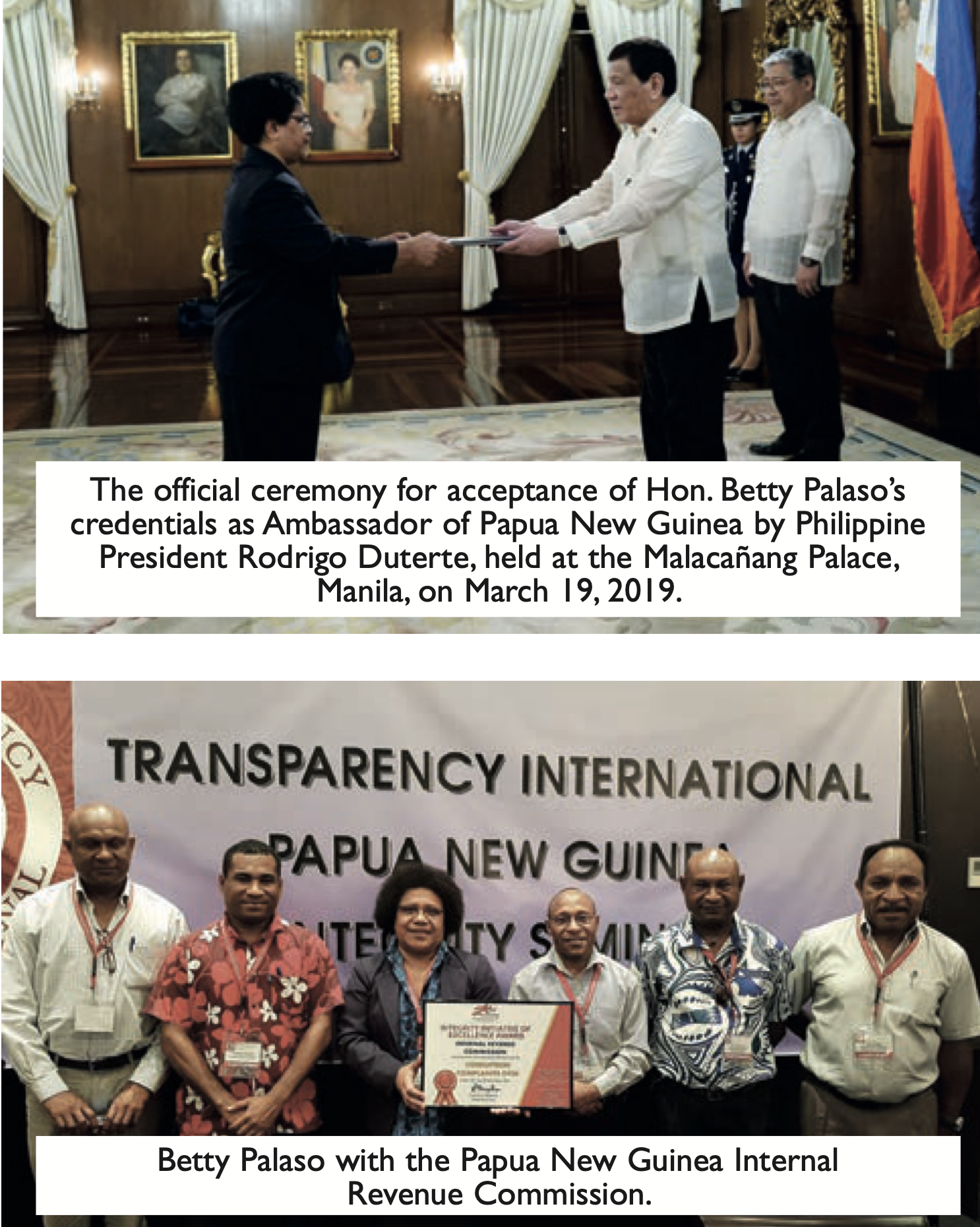
After completing her bachelor’s degree in economics, Palaso joined the country’s Department of Treasury and Finance. In this role, she was privileged to interact with notable organizations such as the International Monetary Fund (IMF) and the World Bank (WB). She became the Internal Revenue Commission (IRC) commissioner general in 2007. During her tenure as a commissioner, which continued until September 2018, she served as a board member of the Bank of Papua New Guinea.
In addition to her civic and professional responsibilities, Palaso continues to be active as a member of the Seventh-day Adventist Church. She leads out as a Sabbath school superintendent and serves as treasurer of her local church. During her free time, she enjoys a number of hobbies, including reading, listening to gospel music, singing, and sightseeing to enjoy the beauty of God’s handiwork. She also enjoys sports; in her younger days she actively played soccer, which earned her a selection to the team representing the national capital of Papua New Guinea. Although she knew there were possibilities of being selected to represent the country, she later opted out because of games falling on the Sabbath.
Let’s begin with your personal and family background.
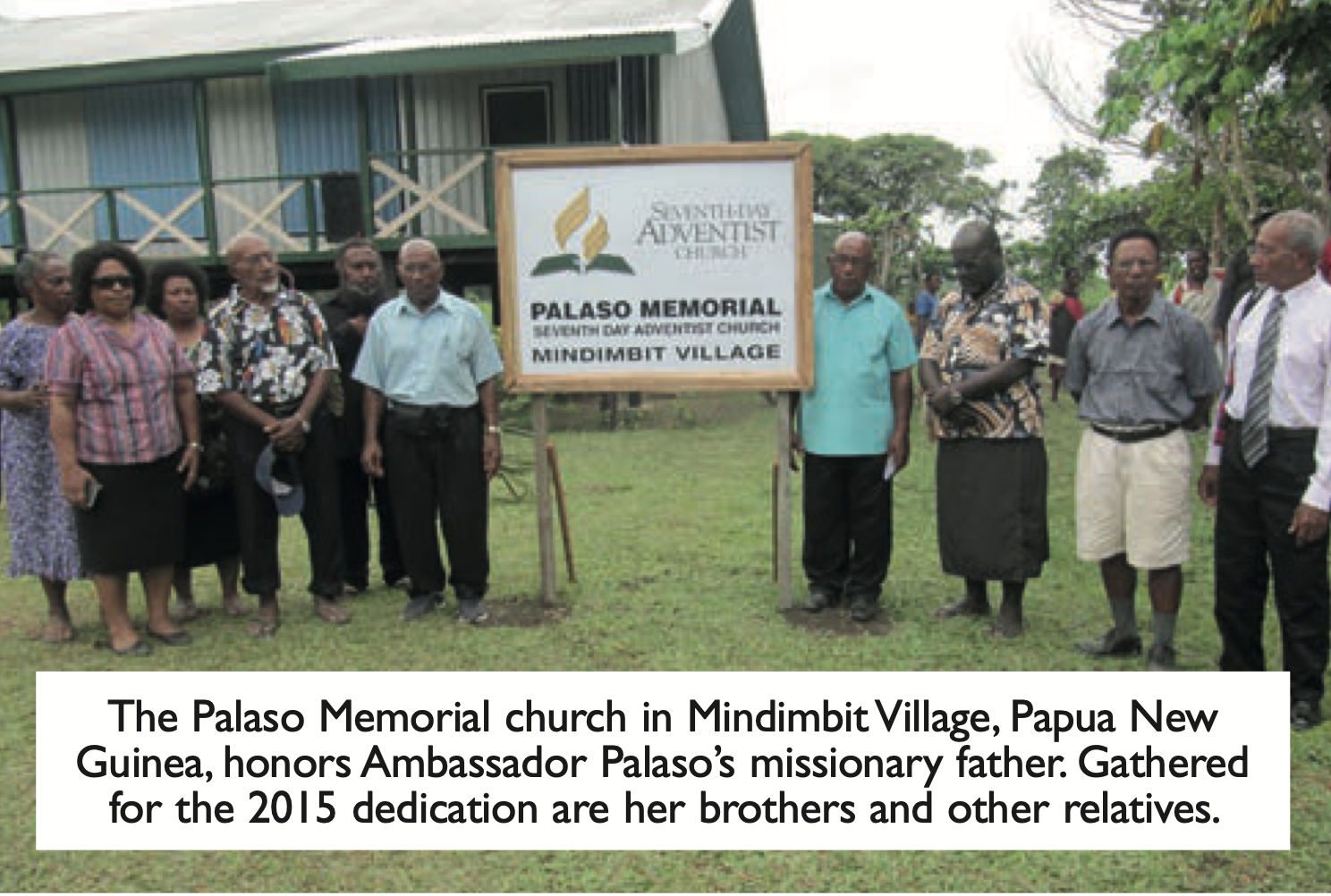
My father was an ordained Seventh-day Adventist pastor and a pioneer missionary to the East Sepik Province in Papua New Guinea. So I, along with my siblings, grew up as missionary children in the rural areas of the country. My mother was a full-time housewife but also assisted my father by sharing the gospel through worship programs, assisting the needy, upholding Christian values at home and in the field and always being there for all of us.
Did you choose to be an Adventist? Was there an incident in your childhood or adolescence that became your turning point?
When I was 6, I was with other children on a wharf beside the Oriomo River in southern Papua New Guinea. An older girl called out to us from a canoe, and I took a misstep and fell into the flowing waters. I did not know how to swim. My sister ran back to the house to get my father. I was struggling under the water when I felt a hand on me. God guided my father to the exact location where I was and rescued me. This experience reminds me that God saved me, and I must do my best to serve Him. The other experience was when I was about to board the plane to depart for Port Moresby for my preliminary year at the university, and my father said, “Never forget God.” That has stuck in my mind up until now.
What major projects or accomplishments have you been involved in during your professional tenure? Have you found any innovative approaches to use in applying your faith?
While I was serving as the commissioner general of the Internal Revenue Commission (IRC), we embarked on several major projects, such as the modernization and transformation of the IRC to a statutory authority, including updating the tax computer system. At that time we were also engaged in other projects that were equally important, such as: (1) making the office building available as a temporary emergency shelter for women feeling threatened; (2) developing a policy ensuring that staff with HIV/ AIDS were not discriminated against in the workplace; (3) affording equal opportunities to workers with disabilities; and (4) providing transportation for female staff to ensure their safety to and from work.
Another important contribution was developing a Zero Tolerance Policy on Corruption in the IRC to prevent fraudulent and dishonest organizational activities or behaviors. We always did half-yearly reviews of the organization’s performance, and I made sure there was a slot in the program for worship or a devotional message; during my time, I invited Adventist pastors to share messages from the Word of God to guide us in our work.
Christian principles of caring for your neighbor, showing kindness and respect for all people, and honoring God in honesty and integrity were built into some of these programs.
What interested you in your current line of work?
I recall my older siblings at the University of Papua New Guinea (UPNG) advising me to consider UPNG as an option after secondary school, and to take up economics. So, I applied for UPNG, where I completed my bachelor’s degree in economics. I have worked in government all my life, and now I serve as a diplomat. This job is completely different from my previous roles, but being an ambassador for the country also provides opportunities for me to help my country to foster bilateral relations and investment opportunities, and for me to be an ambassador for the Lord. Looking back, I believe it was the Lord’s leading for me to be in the field I was in and to acquire the work experience I have had, which I did not think was even possible. Even where I am now and what I do now are only possible with the Lord, and I depend on Him for His guidance.
Can you share more about your work as a diplomat?
I represent the Government of Papua New Guinea in the Republic of the Philippines and am concurrently accredited to the Republic of Palau. My responsibilities include coordinating and initiating bilateral relations between the three governments, assisting government delegations attending official meetings in the host countries and delegations visiting Papua New Guinea, issuance of visas, assisting and protecting citizens with consular issues, and encouraging investment prospects.
What challenges do you face the most, and how do you overcome them? What gives you satisfaction in your work?
The main challenges I have faced are being a female in a leadership position, and standing up for Christian principles in honoring the Sabbath. Sometimes, people do not care about your Christian principles, and you have to do your best to honor God. The satisfaction I get from my work is ensuring that all rules and regulations are complied with, including delivery on any specific requirements, and doing the best I can in reflecting and upholding the values of Christ in word and action.
How do you balance your work and life demands, your desire to serve, and your spiritual life?
Balancing demands of work life and spiritual life can be very challenging. I always ensure I make time for God in the morning before I start my day, and I also end my day with Him. Whenever I encounter challenges, I pray to God, seeking His wisdom and guidance. I recall being in my former role as the commissioner general of the Internal Revenue Commission and at the same time being the treasurer of my church. Being a local church’s treasurer means you have to make time available every week to ensure all tithes and offerings are appropriately recorded, receipted, banked, and accounted for— including transfers to the local mission—and covering all church expenses. It also includes attending church board and business meetings, which are in addition to work requirements. I was asked by some people how I was able to manage both roles. My response was that it is about managing your time, ensuring a balance, making time for God’s work, the government, and other duties as required.
What skills and attitudes prepare a person to work successfully in your current field? What training and experience from home, school, and work prepared you for your current responsibility?
From my own experience, growing up in a Christian home set the foundation for establishing values and principles of honesty, respect, integrity, obedience, love, and caring for others. These values contribute to one’s attitude and shape one’s personality in how one relates to people, society, and the work environment.
Looking back on my journey, particularly as head of the IRC, I can attest to the value of Christian ethics in childhood and life, which has helped to ensure honesty and integrity in managing an organization and the work ethics of the staff and the organization as a whole.
My experience leading the IRC also prepared me well for my current role as an ambassador for the country in ensuring that we comply with all requirements from Papua New Guinea and in the country where I am posted. Importantly, as a leader, you have to lead by example with humility and Christian values.
What advice can you give to university students and young professionals who might be interested in this work? What steps should they take?
Always place God first in your life. Maintain Christian values in your work ethic. Be faithful to little things with honesty and respect; it will impact your life and others as well. You may face tough challenges along the way, but never step away from God, and you will be led all the way.
Rodney Banas (PhD candidate in Educational Administration at the Adventist International Institute of Advanced Studies, Cavite, Philippines) is interested in spiritual leadership, cross-cultural worldviews, educational administration, change management, and crisis communication in higher education institutions. E-mails: [email protected]. Betty Palaso: [email protected].
Recommended Citation
Rodney Banas, "Betty Palaso Papua New Guinea's Ambassador to the Philippines," Dialogue 35:3 (2023): 29-31